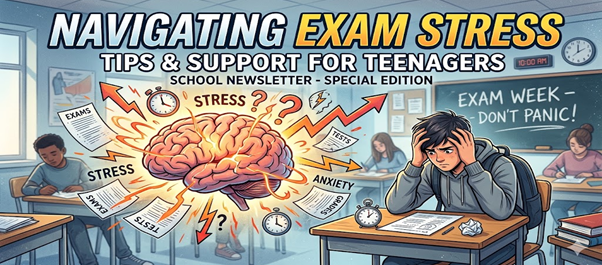
The Exam Brain: How Stress Affects Your Mind and Body
25th April 2026
Does This Sound Familiar?
It is midnight. Your child has been at their desk for four hours. They look up and say: “I have read this page ten times and nothing is going in.” Or perhaps it is your student self — staring at revision notes, willing the words to land. Sound familiar? There is a biological reason for that and understanding it makes all the difference.
A Warm Welcome to Term 3
Welcome back, Braeburn family. We are glad you are here. This term brings with it the energy of rugby season, the milestone of IGCSE examinations, and the final stretch for our Year 13 students. It is a season of great achievement and with it comes pressure.
Our goal as the Nurse’s Office is simple: to help every member of this community thrive, both body and mind. This week, we want to talk about something every student is feeling right now: Stress. Not because stress is always bad, but because understanding it gives you power over it.
What Happens in Your Brain Under Exam Stress?
When a student faces an upcoming exam, the brain interprets it as a potential threat. In response, the body activates what is commonly known as the “fight or flight” response. The hypothalamus — a small but powerful region deep in the brain — sends out a signal that triggers the release of a hormone called cortisol from the adrenal glands.
Cortisol, in the short term, is helpful. It sharpens focus, boosts energy, and prepares the body to perform. This is why some students do well under pressure. However, when stress becomes prolonged — weeks of revision, sleep deprivation and anxiety — cortisol levels remain elevated for too long, and the brain begins to struggle.
High cortisol over time can interfere with the hippocampus — the part of the brain responsible for memory consolidation and recall. In plain language: chronic exam stress can make it genuinely harder to remember what you have studied. This is not laziness or lack of preparation. It is biology.
💡 Research shows that students who sleep fewer than 6 hours before an exam perform significantly worse than those who sleep 8 — even when the sleep-deprived student revised for longer. More revision cannot replace the sleep your brain needs to store what it has learned.
Signs Your Body Is Under Too Much Stress
As a school nurse, some of the most common concerns I see during exam season are not dramatic. They are quiet signals the body sends when it has had enough. Watch for these in yourself or your child:
- Difficulty sleeping or waking up exhausted despite a full night in bed
- Frequent headaches, particularly in the mornings or after long study sessions
- Stomach upsets, nausea or loss of appetite — the gut and the brain are deeply connected
- Irritability, mood swings, or feeling tearful without a clear reason
- Difficulty concentrating — reading the same paragraph over and over
- A feeling of being frozen — unable to start revision even though there is plenty to do
If any of this sound familiar, please do not dismiss them. The Nurse’s Office is open and we are here not just for physical injuries, but for the whole student.
What Can You Actually Do About It?
The good news is that the brain is remarkably responsive to simple, consistent habits. You do not need a complicated plan — just a few things done well and done regularly.
For Students — Small Habits, Big Brain Benefits:
- Sleep 8–9 hours: this is when the brain literally files and stores what you have learned. Cutting sleep to study more is counterproductive.
- Take real breaks: the brain consolidates learning during rest, not during study. A 10-minute walk between subjects is not wasted time — it is smart revision.
- Stay hydrated: even mild dehydration reduces cognitive performance. Always keep water nearby.
- Eat breakfast on exam days: the brain runs on glucose. A banana, eggs or porridge is better fuel than an empty stomach.
- Talk to someone: stress carried silently grows heavier. A friend, a parent, a teacher, the school counsellor or the school nurse — any trusted adult is a good place to start.
- Give yourself permission to not be okay some days. Acknowledging stress out loud actually reduces its power over you.
For Parents — How to Support Without Increasing Pressure:
- Ask “how are you feeling?” more than “how is revision going?”
- Ensure the home environment supports sleep — screens off at a reasonable hour, a calm atmosphere before bed.
- Offer nourishing meals and snacks. Avoid making food a battleground during this season.
- Notice without catastrophising. If your child seems overwhelmed, acknowledge it calmly rather than adding urgency.
- Remind them: exams measure performance on a day, not their worth as a person.
A Note from the Health Team
This term we are committed to walking alongside students, parents and staff through what is genuinely a demanding season. The Nurse’s Office is a space of support — confidential, non-judgemental and always open during school hours.
If you or your child is struggling — whether it is stress, sleep, appetite, mood or simply a feeling that something is “off” — please do not wait.
You are welcome to walk in or ask your Form Tutor to refer you. No appointment needed. An early conversation is always easier than a crisis managed too late.
Pauline Muthee
School Nurse