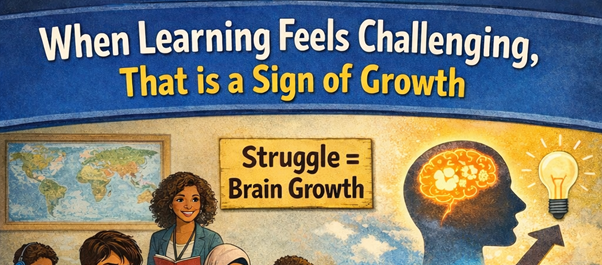
🧠 When Learning Feels Challenging?
28th February 2026
This week, a student walked out of a lesson and said, “That was hard.”
Not frustrated. Not upset. Just thoughtful.
When asked what made it hard, the student replied, “We had to really think about it before Sir explained it.”
That moment is worth celebrating.
Did you know?
The brain grows most when it is working hard, not when it is simply listening.
In classrooms, it can feel reassuring when a teacher explains everything step by step, and students follow along smoothly. It feels clear. It feels organised. It feels efficient.
But deep learning, the kind that lasts beyond the test, requires something more.
It requires thinking.
As the educational researcher John Hattie reminds us:
“The biggest effects on student learning occur when teachers become learners of their own teaching and students become their own teachers.”
That is the balance we continually strive for.
What Does Strong Teaching Look Like?
Strong teaching is not about how much a teacher talks.
It is about how much students think.
In our classrooms, teachers:
- Introduce new ideas clearly
• Model how to approach problems
• Check understanding carefully
• Guide students through misconceptions
• Provide feedback that moves learning forward
Alongside this, students are expected to:
- Attempt before being shown
• Explain their reasoning
• Learn from mistakes
• Discuss and refine ideas
• Persevere through difficulty
This balance builds confidence, independence, and long-term understanding.
Why We Do Not Always Explain Everything Immediately
When students encounter a challenging task, it can feel uncomfortable. The natural instinct, for adults and young people alike, is to want the answer quickly.
However, when students are given time to grapple with a question before it is explained:
- They activate prior knowledge
• They build problem-solving skills
• They retain learning more effectively
• They develop resilience
This does not mean teachers step back. It means teachers step in strategically.
Teachers carefully judge when to:
- Provide a direct explanation
• Ask guiding questions
• Model a process
• Or allow students to think further
This is deliberate and grounded in strong research on how learning works.
“But My Child Says the Teacher Did Not Teach”
Sometimes when learning feels harder, students may say:
“We had to figure it out ourselves.”
In reality, what they are describing is structured thinking. They are being taught, but in a way that builds independence rather than dependency.
Teachers ensure that:
- Clear instruction is given
• Key concepts are explicitly taught
• Students are not left confused
• Support is available when needed
Challenge is never the absence of teaching. It is part of teaching.
Preparing Students for Examinations and Beyond
Examinations require students to:
- Apply knowledge independently
• Think under pressure
• Analyse unfamiliar questions
• Justify their reasoning
These skills cannot be built through listening alone.
By encouraging students to think deeply in lessons before answers are revealed, we strengthen their ability to perform confidently in formal assessments and in future study.
As the psychologist Carol Dweck writes:
“Becoming is better than being.”
When learning feels demanding, growth is taking place.
If your child says, “It was hard,” that is not necessarily a problem.
Very often, it is progress.
Noela Gichuru
Deputy Headteacher – Academic